About BUS-FPX4043 Assessment 1
BUS-FPX4043 Assessment 1 is a strategic human resource deliverable that requires the undergraduate business learner to design a comprehensive compensation philosophy balancing competitive pay, internal equity, and financial sustainability. This educational model develops a compensation strategy for ClearPath Digital Solutions LLC, a fictional 30-employee technology services company located in Austin, Texas. By studying this specific sample, learners will master how to align organizational goals with specific salary decisions, such as targeting the 60th percentile of the labor market and establishing exact incentive structures like an 8 percent bonus for exempt staff. This overview provides the exact structural framework needed to analyze external market data, formulate employee benefits, and satisfy the strict Capella scoring guide mandates for compensation management.
Course context: view the BUS-FPX4043 course hub for the course overview and complete assessment sequence.
Full BUS-FPX4043 Assessment 1 Sample
BUS-FPX4043 Assessment 1: Creating a Compensation Philosophy examines how a growing organization can design a compensation strategy that balances competitive pay, internal equity, employee performance, benefits, legal compliance, and financial sustainability. This educational sample uses a fictional Austin, Texas technology company to demonstrate how a compensation philosophy can guide salary, incentive, and benefits decisions.
The sample is designed for students reviewing BUS-FPX4043 Compensation and Benefits Management and focuses on practical compensation decisions such as market positioning, exempt and nonexempt classifications, salary-setting criteria, incentive opportunities, employee benefits, and local labor-market competition.
Educational sample notice: This sample is provided for learning and research purposes. Students should review their current assessment instructions and scoring guide, verify all sources, and develop an original submission based on their own analysis.
BUS-FPX4043 Assessment 1 Creating a Compensation Philosophy Sample Overview
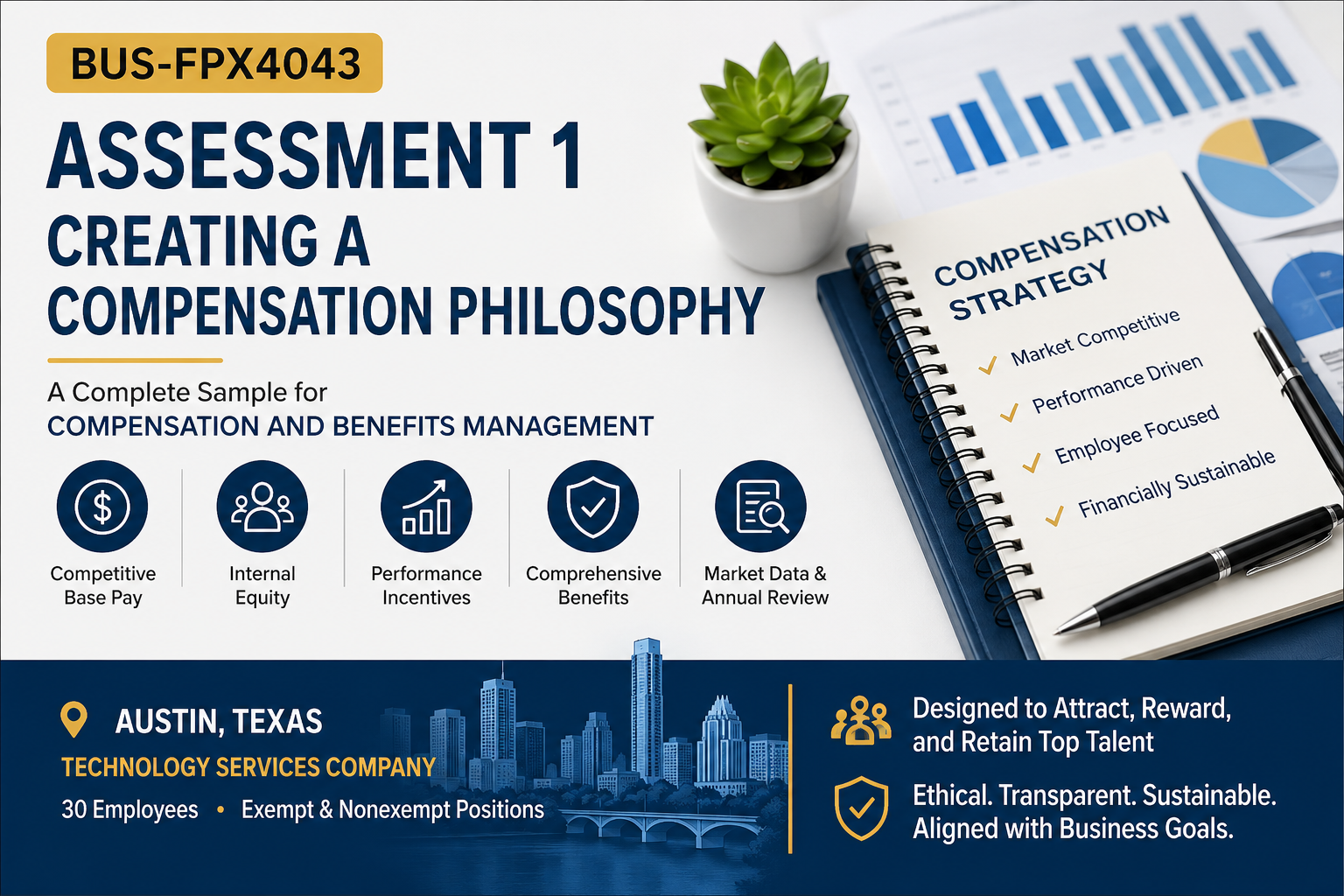
A compensation philosophy is a set of principles that explains how an organization intends to pay and reward employees. It guides decisions about base salary, incentives, employee benefits, internal equity, external competitiveness, and pay progression. A strong compensation philosophy should support the organization's business strategy while remaining consistent, understandable, legally compliant, and financially sustainable.
In this BUS-FPX4043 Assessment 1 sample, the compensation philosophy is developed for ClearPath Digital Solutions LLC, a fictional technology services company located in Austin, Texas. The company must compete for technical talent while operating with the financial limitations of a new business. Its compensation strategy therefore combines moderately aggressive base pay, meaningful employee benefits, performance-based incentives, transparent salary practices, and regular market review.
Company Overview
ClearPath Digital Solutions LLC will be a new technology services company based in Austin, Texas. The organization will provide accessible website development, cybersecurity system maintenance, and technical support services for small businesses, nonprofit organizations, and community health clinics throughout Central Texas.
The organization will begin operations with approximately 30 employees. Ten positions will be classified as exempt positions, including the chief executive officer, four functional managers, and five software developers. Twenty positions will be nonexempt positions, including web technicians, quality-assurance technicians, customer-support specialists, inside sales representatives, and administrative assistants.
Employee classification will not be determined by job title alone. Instead, ClearPath will evaluate actual job duties, compensation arrangements, and applicable wage-and-hour requirements when determining whether a position qualifies for exempt or nonexempt status. This approach reduces the risk of using impressive job titles to justify classifications that are inconsistent with the work employees actually perform.
Proposed Compensation Philosophy
ClearPath Digital Solutions will use a compensation philosophy based on five core principles: external competitiveness, internal equity, performance recognition, transparency, and financial sustainability.
The company will seek to provide compensation that is competitive enough to attract employees in the Austin technology market without attempting to outspend much larger technology corporations. Base salaries will therefore be supported by above-average benefits, flexible work arrangements, professional-development opportunities, meaningful projects, and clear career-growth opportunities.
Internal equity will also be a central part of the philosophy. Employees performing work of comparable value should receive reasonably comparable compensation when factors such as responsibilities, experience, qualifications, specialized skills, and performance are considered. Compensation differences should be explainable using documented business criteria rather than inconsistent negotiation or managerial preference.
Finally, compensation commitments must remain affordable. A salary or benefit program that cannot be sustained during slower revenue periods could eventually create layoffs, benefit reductions, or inconsistent treatment of employees. ClearPath will therefore balance competitive compensation with long-term payroll sustainability.
Salary Decision Factors
ClearPath will use several factors when determining employee salaries. No single factor will determine compensation independently. Instead, salary decisions will consider the requirements of the position, the external labor market, the employee's qualifications, internal pay relationships, and the company's financial capacity.
Job Responsibilities and Scope
The first consideration will be the responsibilities attached to the position. Jobs with greater decision-making authority, technical complexity, accountability, organizational impact, or supervisory responsibility will generally command higher salary ranges than positions with narrower responsibilities.
This approach helps ClearPath establish compensation based on the value and demands of the job rather than relying only on an individual's previous salary or negotiating ability.
External Market Data
Local salary information will be used to understand what competing employers are paying for similar skills in the Austin labor market. Market data can help ClearPath identify whether a proposed salary range is significantly below, near, or above prevailing compensation levels.
However, market data will serve as a benchmark rather than an automatic salary formula. Jobs with similar titles can have different responsibilities, technical requirements, performance expectations, and organizational impact.
Education, Experience, and Certifications
Relevant education and professional experience will influence starting pay and salary progression when those qualifications contribute to an employee's ability to perform the job.
Professional certifications may also support higher compensation when they provide skills that are valuable to the business. This may be particularly relevant for cybersecurity, software development, accessibility, project management, and other technical positions where verified expertise can directly affect service quality.
Specialized and Scarce Skills
Some technical skills may be difficult to recruit in the Austin labor market. ClearPath may therefore pay a premium for specialized competencies when labor-market evidence demonstrates that those skills are scarce and strategically important.
Any premium should be documented and periodically reviewed. A skill that is scarce today may become more widely available later, so compensation decisions should not become permanent simply because a temporary labor shortage once existed.
Internal Equity
ClearPath will compare proposed salaries with the compensation of employees performing similar or comparable work within the organization. The objective is to reduce unexplained pay differences and maintain reasonable relationships among positions.
Internal equity is especially important when hiring new employees. Competitive labor markets can pressure employers to offer new hires considerably more than current employees performing similar work. ClearPath should therefore examine both market competitiveness and existing employee pay before approving starting salaries.
Employee Performance
Performance will influence an employee's movement within an established salary range. Employees who consistently demonstrate high-quality work, increased capabilities, stronger results, or expanded responsibilities may progress more quickly through the range.
Performance, however, should not be used to justify inconsistent starting salaries that cannot be explained by legitimate differences in qualifications, responsibilities, experience, or market conditions.
Market Position and Base Pay Strategy
ClearPath will target base salaries at approximately the 60th percentile of the Austin technology labor market. This position places the organization above the market midpoint while remaining below the highest-paying segment of the market.
The strategy supports the company's recruitment goals without requiring it to match the compensation levels offered by the largest technology organizations operating in Austin.
Published U.S. Bureau of Labor Statistics data cited in the original assessment reported Austin-area mean hourly wages of approximately:
- $56.16 per hour for computer and mathematical occupations.
- $67.01 per hour for software developers.
- $29.47 per hour for computer user support specialists.
These figures provide useful external benchmarks for positions likely to exist at ClearPath. The organization should nevertheless adjust market information for job scope, required experience, specialized skills, internal equity, and organizational affordability before establishing final salary ranges.
Why the 60th Percentile Is Appropriate for ClearPath
A 60th-percentile strategy provides a reasonable compromise between recruitment competitiveness and financial control. Paying at or below the market midpoint could make it difficult for a new organization to recruit technology professionals in a market containing large and well-known employers.
Conversely, attempting to lead the market by paying at the 75th or 90th percentile would significantly increase fixed payroll costs for a company that has not yet established a long operating history or predictable revenue base.
ClearPath can therefore use base pay near the 60th percentile and strengthen the total rewards package through benefits, flexibility, professional development, transparent pay practices, and performance incentives.
Incentive Pay Strategy
ClearPath will supplement base compensation with annual performance incentives. Eligible exempt employees may earn an incentive of up to 8 percent of base salary, while eligible nonexempt employees may earn up to 5 percent of base salary.
The incentive program should combine organizational, team, and individual performance measures. Potential measures include:
- Client retention.
- Customer satisfaction.
- Service quality.
- Project completion and delivery performance.
- Security and compliance outcomes.
- Team performance.
- Individual contribution.
Using multiple measures helps reduce the risk of rewarding employees for one result while unintentionally encouraging poor behavior somewhere else. For example, rewarding employees exclusively for project speed could encourage rushed work and lower quality. Similarly, rewarding sales volume alone could encourage employees to pursue customers who are not appropriate for the company's services.
The incentive system should therefore reinforce overall organizational performance rather than encourage employees to sacrifice teamwork, service quality, cybersecurity, or customer relationships in order to maximize an individual bonus.
Base Pay Should Remain the Foundation of Compensation
Incentive compensation should reward strong performance, but it should not replace competitive and equitable base pay. Employees rely on salary or hourly compensation for financial stability, while incentive awards can vary from one performance period to another.
ClearPath should therefore establish reasonable base salaries first and then use incentive compensation as an additional mechanism for recognizing performance.
Employee Benefits Strategy
ClearPath will use an above-market benefits strategy to strengthen its total compensation package. This approach is particularly important because the organization does not intend to compete with the highest-paying technology companies solely through salary.
The proposed benefits package will include:
- Medical insurance.
- Dental insurance.
- Vision coverage.
- A 401(k) retirement plan with a 4 percent employer match.
- Paid vacation.
- Paid sick leave.
- Paid holidays.
- Parental leave.
- Hybrid-work opportunities.
- Professional-development support.
The company will pay most of the employee-only health insurance premium while reviewing benefit costs annually.
Health and Financial Security
Medical, dental, and vision coverage support employee health and reduce uncertainty associated with major health-care expenses. Retirement contributions provide longer-term financial value and can strengthen employee retention.
Work-Life Balance
Vacation, sick leave, holidays, parental leave, and hybrid work can be especially valuable in occupations where employees have alternative employment opportunities. Flexible work arrangements can also help ClearPath compete with larger employers without adding the same level of permanent payroll expense that would result from substantially higher salaries.
Professional Development
Technology skills change rapidly. Professional-development support can therefore serve two purposes: it provides employees with a valuable benefit while also helping the organization maintain current technical capabilities.
Training assistance, certification support, conferences, workshops, or other development opportunities may be particularly valuable for employees working in software development, cybersecurity, web accessibility, and technical support.
Competing for Talent in the Austin Labor Market
Austin's employment market creates significant competition for technology and support workers. The original assessment identifies major employers such as Apple, Dell Technologies, Samsung, Tesla, Google, IBM, and Oracle as organizations that influence local compensation expectations.
A new 30-person company is unlikely to match every salary, benefit, or career opportunity provided by very large corporations. ClearPath therefore needs a differentiated employee value proposition.
The organization can compete by emphasizing:
- Transparent salary ranges.
- Flexible and hybrid work arrangements.
- Meaningful projects serving local organizations.
- Direct access to organizational leaders.
- Greater visibility of individual contributions.
- Professional-development opportunities.
- Clearly defined career paths.
- Competitive benefits.
- Fair and understandable compensation decisions.
These features cannot completely replace competitive compensation, but they can increase the overall value of working for ClearPath.
Internal Equity and Pay Transparency
Internal equity should be treated as an ongoing management responsibility rather than a one-time salary exercise. The human resources manager will document unusual compensation decisions and conduct an annual pay-equity review.
The review should evaluate whether employees performing similar work are paid consistently after legitimate factors such as experience, performance, qualifications, responsibilities, and specialized skills are considered.
ClearPath should also establish salary ranges that communicate the minimum, midpoint, and maximum compensation opportunity for each job or job family. Managers should understand what factors justify placement at different points within each range.
This approach improves consistency and makes compensation decisions easier to explain to employees.
Compensation Governance and Annual Review
The compensation program should be reviewed at least annually. A compensation philosophy becomes ineffective when salary structures, benefits, or market assumptions remain unchanged while the labor market and organization continue to evolve.
ClearPath's annual review should examine:
- External salary-market data.
- Employee turnover.
- Recruitment difficulties.
- Internal pay equity.
- Employee feedback.
- Benefit utilization and cost.
- Incentive-program outcomes.
- Organizational revenue and payroll affordability.
- Changes in jobs and responsibilities.
If the company repeatedly struggles to recruit a particular technical position, the salary range may no longer reflect market conditions. If employees leave because benefit costs are too high, the organization may need to reconsider the way costs are shared. If employees perceive incentive measures as unfair, management should examine whether the measures actually reflect work employees can influence.
Summary of the ClearPath Compensation Strategy
| Compensation Area | Proposed Strategy |
|---|---|
| Organization | ClearPath Digital Solutions LLC, Austin, Texas |
| Starting Workforce | 30 employees |
| Exempt Positions | 10 positions |
| Nonexempt Positions | 20 positions |
| Base Pay Position | Approximately the 60th percentile of the Austin technology market |
| Exempt Incentive Opportunity | Up to 8% of base salary |
| Eligible Nonexempt Incentive Opportunity | Up to 5% of base salary |
| Retirement Benefit | 401(k) with a 4% employer match |
| Primary Compensation Goals | Recruitment, retention, internal equity, performance, transparency, and sustainability |
Conclusion
ClearPath Digital Solutions requires a compensation philosophy that is competitive enough to recruit technology employees while remaining financially realistic for a new organization. Targeting base pay near the 60th percentile of the Austin market provides a balanced starting point because it places the company above the market midpoint without requiring it to compete directly with the highest-paying technology employers.
The proposed compensation program strengthens that position through annual incentive opportunities, comprehensive employee benefits, hybrid work, professional development, transparent salary ranges, and regular pay-equity review. Salary decisions are based on job responsibilities, labor-market information, education, relevant experience, certifications, specialized skills, performance, internal equity, and organizational affordability.
Most importantly, ClearPath's compensation philosophy treats compensation as an integrated system rather than simply a salary number. Base pay, incentives, benefits, employee development, market competitiveness, internal equity, and financial sustainability must work together. Reviewing those elements annually will help the organization maintain a compensation program that supports employees while advancing long-term business objectives.
References
Opportunity Austin. (2026). Major employers. https://opportunityaustin.com/state-of-the-atx-economy/major-employers/
U.S. Bureau of Labor Statistics. (2025, June 17). Occupational employment and wages in Austin-Round Rock-San Marcos—May 2024. https://www.bls.gov/regions/southwest/news-release/occupationalemploymentandwages_austin.htm
BUS-FPX4043 Assessment 1 Frequently Asked Questions
What is BUS-FPX4043 Assessment 1 about?
This BUS-FPX4043 Assessment 1 sample is a structural model that evaluates the precise formulation of a compensation philosophy for a 30-employee technology company. You must utilize this listing to study the exact relationships between external market data, internal equity, and executive human-resource decisions for a fictional entity, ClearPath Digital Solutions LLC, located in Austin, Texas.
What should a compensation philosophy include?
A comprehensive compensation philosophy must incorporate 5 core principles, including external competitiveness, internal equity, and financial sustainability. This structural framework provides consistent principles that executive decision-makers use to govern base pay, incentive compensation, and salary progression.
What market position does ClearPath use in this sample?
ClearPath targets base compensation strictly at the 60th percentile of the Austin technology labor market. This specific percentile supports competitive recruitment while avoiding the unsustainable fixed payroll costs of matching the highest-paying technology corporations.
What factors are used to determine employee salaries?
Executive decision-makers determine starting pay by evaluating specific salary decision factors, such as job responsibilities, specialized skills, and education. This analytical approach reduces unexplained pay differences and strictly relies on external market data and internal equity rather than individual negotiation.
How does incentive pay work in the compensation philosophy?
The incentive strategy awards eligible exempt employees up to 8 percent of their base salary and eligible nonexempt employees up to 5 percent. These exact awards require the achievement of specific organizational metrics, such as customer satisfaction, service quality, and project completion rates, to prevent skewed employee behavior.
Why are employee benefits important to the compensation strategy?
Employee benefits establish a competitive total rewards package that differentiates a 30-employee employer from larger competitors. The proposed benefits strategy includes specific offerings, like hybrid-work opportunities, parental leave, and a 401(k) plan with a 4% employer match.
Why is internal equity important in compensation management?
Internal equity ensures that employees performing comparable work receive consistent compensation by evaluating legitimate differences in specialized skills, qualifications, and performance. Management must audit the compensation program annually to review internal pay equity and resolve unexplained compensation differences
Required Assessment Deliverables and Structure
This sample systematically constructs a market-aligned compensation strategy for a growing business. It strictly covers the following mandatory sections:
Company Overview: Defines the fictional ClearPath Digital Solutions LLC, establishing a 30-employee workforce divided into exactly 10 exempt and 20 nonexempt positions based on actual job duties.
Proposed Compensation Philosophy: Outlines the 5 core principles governing base salary, incentives, internal equity, transparency, and financial sustainability.
Salary Decision Factors: Details how external market data, specialized technical skills, and internal equity interact to determine starting pay without relying solely on individual negotiation.
Market Position and Base Pay Strategy: Justifies targeting the 60th percentile of the Austin technology market using 3 specific BLS hourly wage benchmarks for computer and software occupations.
Incentive and Benefits Strategy: Proposes distinct annual bonuses (8% exempt, 5% nonexempt) and a comprehensive benefits package to differentiate the employer from larger competitors like Dell, Apple, and Tesla.
Compensation Governance and Annual Review: Establishes a mandatory annual audit examining external salary-market data, internal pay equity, and overall payroll affordability.
BUS-FPX4043 Assessment 1 Compensation Philosophy Sample Overview
Rubric-Aligned Competency Requirements
To achieve a distinguished score, your submission must successfully execute the following analytical steps:
- Design 1 comprehensive compensation philosophy based on 5 core principles, including external competitiveness, internal equity, and financial sustainability.
- Evaluate local labor-market conditions using specific empirical data, such as U.S. Bureau of Labor Statistics (BLS) wage estimates of $67.01 per hour for software developers.
- Define clear salary decision factors, such as job responsibilities, specialized skills, and education, to reduce unexplained pay differences within the organization.
- Formulate an exact incentive pay strategy utilizing multiple performance measures, including client retention and service quality, to prevent skewed employee behavior.
- Establish a competitive total rewards package containing specific employee benefits, like hybrid-work opportunities, parental leave, and a 4% 401(k) employer match.
- Audit the compensation program annually to review 9 specific governance metrics, including employee turnover, recruitment difficulties, and benefit utilization costs.
Educational Support and Resource Integration
Execute your BUS-FPX4043 Assessment 1 compensation philosophy proposal by connecting market pay data with strategic human resource planning. Utilize the following internal guides to bridge the information gap between analyzing labor market statistics and formatting an executive-ready business deliverable.
Assessment hierarchy
- BUS-FPX4043 course hub — course overview and the complete assessment sequence.
Supporting guides for evidence and implementation
- Capella BS Business Assignment Help Map this specific compensation management task to your broader degree progression using the Capella BS Business Assignment Help guide.
- FlexPath Assessment Submission Checklist Audit your financial assumptions, salary decision factors, and rubric criteria before submission using the FlexPath Assessment Submission Checklist.
- Capella FlexPath time management Structure your 12-week workflow to execute market research, pay modeling, and executive drafting on time using the Capella FlexPath time management guide.
Frequently asked questions
What does this BUS-FPX4043 Assessment 1 sample evaluate?
This sample evaluates the precise formulation of a compensation philosophy, establishing a structured approach to human-resource analysis, market data application, and executive decision-making.
How must I utilize this business assessment sample?
You must use this sample exclusively to study structural framework application, evidence integration, and professional communication standards. It strictly prohibits direct copying or submission as original coursework.
Does this sample provide legally binding employment-law advice?
No. You must analyze employment-law topics strictly within the boundaries of the assigned academic scenario, utilizing only your required courseroom sources and specific jurisdictional guidelines.
Does this reference replace official BUS-FPX4043 instructions?
No. You must definitively confirm your current Capella courseroom title, scenario, framework, data templates, and scoring-guide criteria before commencing your final submission.
Study and academic-use guidance
Use this sample to study structure, evidence relationships, analytical sequencing, and scoring-guide alignment. Build your own response from the current courseroom requirements.
- Verify the current instructions, template, evidence requirements, and scoring guide.
- Create your own analysis, calculations, visuals, citations, and conclusions.
- Check factual, clinical, legal, numerical, and source claims before submission.
Independent resource: FlexPath Assignment Help is not affiliated with or endorsed by Capella University. Do not submit sample wording or analysis as your own work.