About NURS-FPX4040 Assessment 2
NURS-FPX4040 Assessment 2 is presented here as an independent educational model of a privacy best-practice communication. This 2-page staff update shows how a nurse can distinguish protected health information, privacy, confidentiality, and security while connecting authoritative guidance with everyday digital behavior. The sample discusses social media, mobile devices, approved communication methods, and incident reporting. Compare its content and format with the current instructions and scoring guide before creating an original staff communication.
Course context: view the NURS-FPX4040 course hub for the course overview and published assessments.
Full NURS-FPX4040 Assessment 2 Sample
NURS-FPX4040 Assessment 2 PHI Privacy Security and Confidentiality Best Practice
Course: NURS-FPX4040: Managing Health Information and Technology
Assessment: Assessment 2
Sample Type: Two-page interprofessional staff update plus references
Author: FlexPath Assignment Help
Educational sample notice. This original model demonstrates one way to organize a staff communication about PHI privacy, confidentiality, and security. Learners should compare it with the current courseroom instructions and scoring guide, verify all sources, and create their own submission.
Interprofessional Staff Update: Protect PHI On-Site and Online
Purpose: This staff update gives nurses and other team members a short, practical standard for protecting electronic protected health information (ePHI), especially when using mobile devices, secure messaging, email, photos, and social media.
Know the Three Responsibilities
Privacy concerns appropriate use and disclosure of health information. Confidentiality concerns the professional protection of information entrusted through care. Security concerns administrative, physical, and technical safeguards that protect ePHI. HIPAA does not mean “never share information.” Whether PHI may be used or disclosed depends on the purpose, the applicable HIPAA provision, and organizational policy. HHS explains that the Privacy Rule generally applies a minimum-necessary standard to many uses, disclosures, and requests, but identifies exceptions, including disclosures to or requests by a health care provider for treatment purposes.
Five Rules for Daily Practice
- Access only for an authorized role and purpose. Never open a chart because you are curious about a coworker, family member, celebrity, or former patient. EHR access can be audited.
- Use approved communication tools. Send patient information through the organization’s secure messaging, approved EHR functions, or approved encrypted email. Do not copy PHI to personal email, consumer messaging apps, or personal cloud storage.
- Protect devices and screens. Lock the workstation when stepping away. Do not share passwords. Use multifactor authentication when provided. Keep printed patient lists face down or secured and place confidential waste in approved bins.
- Do not photograph patients or records on a personal device. Clinical images should be captured only under the organization’s approved workflow, device, consent, and storage policy.
- Report through the approved incident pathway promptly. If a device is lost, a suspicious link is clicked, information is sent to the wrong person, or PHI appears on social media, follow the organization’s current privacy or security reporting process. Prompt reporting can help the responsible team limit further exposure or disruption.
Social Media: The Safest Rule Is Do Not Post Patient Stories
A post does not need a patient name to create a privacy problem. A diagnosis, unusual event, room location, date, photograph, age, or workplace detail can make a patient identifiable when combined with other information. Deleting a post does not reliably remove copies, screenshots, cached versions, or shares. Never assume that a “private” group, disappearing story, or closed account makes patient information safe.
Unsafe example: “Hard shift tonight. We saved a 19-year-old crash victim from the rollover on Highway 8.”
Even without a name, the age, event, timing, and location could identify the patient. Safer action: Do not post the event. Discuss clinical experiences only in approved education or debriefing settings with identifying information removed and according to policy.
Why Interprofessional Collaboration Matters
Privacy and security are team responsibilities. Nurses, providers, pharmacists, therapists, registrars, health information management staff, information technology staff, and leaders all create, access, transmit, and protect patient information. A weak link in one area can expose the entire record. Nurses should know whom to contact for privacy questions, cybersecurity concerns, and urgent access problems. Managers and trusted peers also matter: research on nurses’ information-security awareness shows that nurses often rely on managers, colleagues, and IT professionals for security information (Magdalinou et al., 2023).
Cybersecurity can also affect patient safety when disrupted systems delay or prevent access to information or clinical services. Nursing education can therefore address phishing recognition, password safety, secure device use, and incident reporting when these issues are relevant to the organization and role (Kang & Seomun, 2023; Ruppel & Funk, 2023).
Quick Response: Stop - Protect - Report
STOP: Do not continue sending, posting, forwarding, or opening suspicious content.
PROTECT: Follow the organization’s current procedure to secure the device or information and preserve relevant details. Do not improvise technical containment steps that conflict with policy.
REPORT: Contact the privacy, information-security, help-desk, compliance, or supervisory contact identified by the organization’s current incident pathway. Do not make a legal breach determination or conduct an independent investigation unless that is part of your authorized role.
Staff Takeaway
Protecting PHI is part of professional nursing practice, not just an IT rule. Use approved systems, access information only for an authorized role and purpose, keep patient stories off social media, secure devices according to policy, and report suspected problems through the current organizational pathway.
References
Kang, J., & Seomun, G. (2023). Development and validation of the information security attitude questionnaire (ISA-Q) for nurses. Nursing Open, 10(2), 850-860. https://doi.org/10.1002/nop2.1353
Magdalinou, A., Kalokairinou, A., Malamateniou, F., & Mantas, J. (2023). SNA: The optimal nodes to raise nurses’ infosec awareness. Studies in Health Technology and Informatics, 305, 321-322. https://doi.org/10.3233/SHTI230494
Ruppel, H., & Funk, M. (2023). Cyber hygiene concepts for nursing education. Nurse Education Today, 130, 105940. https://doi.org/10.1016/j.nedt.2023.105940
U.S. Department of Health and Human Services. (n.d.). The HIPAA Privacy Rule. https://www.hhs.gov/hipaa/for-professionals/privacy/index.html
U.S. Department of Health and Human Services. (n.d.). The Security Rule. https://www.hhs.gov/hipaa/for-professionals/security/index.html
Assessment Coverage Map
| Feature Illustrated in This Sample | Where the Sample Addresses It |
|---|---|
| Distinguish privacy, security, and confidentiality for electronic PHI. | Know the Three Responsibilities; Five Rules for Daily Practice. |
| Explain why interdisciplinary collaboration is needed. | Why Interprofessional Collaboration Matters. |
| Address social media risks and appropriate use. | Social Media: The Safest Rule Is Do Not Post Patient Stories. |
| Provide evidence-informed safeguards and an organization-dependent incident response. | Five Rules; Quick Response: Stop - Protect - Report. |
| Communicate in a concise staff-update format. | Two-page update structure, short headings, action-oriented language. |
How This Sample Is Organized
This 2-page sample demonstrates one way to organize a concise staff communication about digital safety. It includes:
- Three Responsibilities: Distinguishes privacy, confidentiality, and information security.
- Five Rules for Daily Practice: Gives sample guidance about EHR access, approved communication tools, screen protection, clinical photography, and incident reporting.
- Social Media Risks: Explains how combined details may identify a patient even when a name is omitted.
- Interprofessional Collaboration: Connects privacy and cybersecurity practices with the roles of nurses, other clinicians, leaders, and technical staff.
- Quick Response—Stop, Protect, Report: Provides a sample response sequence that remains subject to the organization’s current incident policy.
These sections describe this model. Current instructions, authoritative guidance, faculty direction, and organizational policy control the learner’s own work.
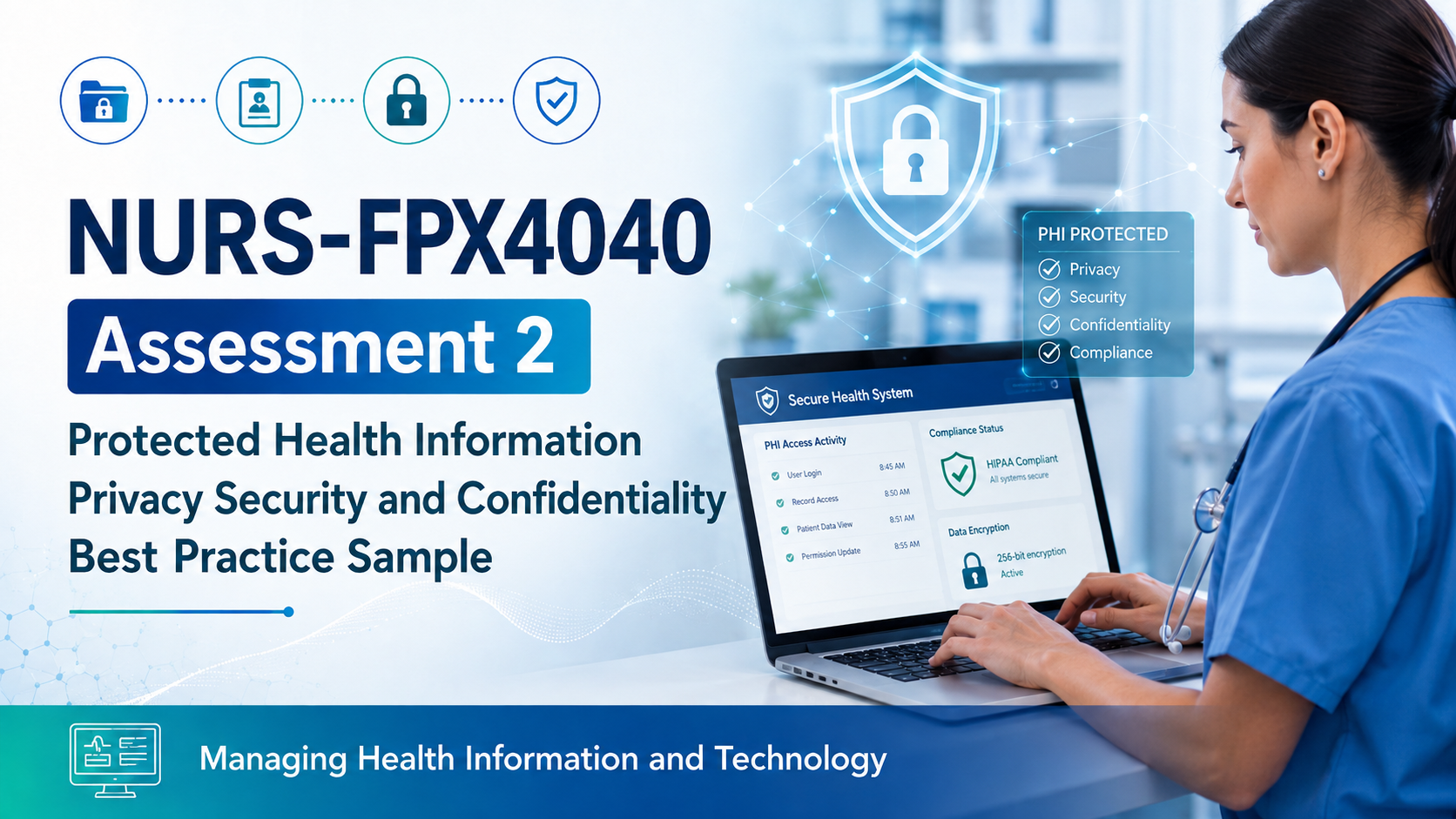
NURS-FPX4040 Assessment 2 PHI Privacy Security and Confidentiality at a glance
Analytical Moves Demonstrated in the Sample
This model illustrates the following analytical moves. Adapt them only where they fit the current instructions, authoritative guidance, and organizational context:
- Distinguish privacy, confidentiality, information security, and electronic PHI without treating them as interchangeable.
- Identify how combined clinical or workplace details may create identification and disclosure risk.
- Explain how nurses, other clinicians, leaders, and technical staff contribute to information protection.
- Connect safeguards such as access controls, authentication, secure messaging, and device practices to the risks they address.
- Describe a response process that follows the organization’s current privacy, security, and incident-reporting policy. This sample uses “Stop, Protect, Report.”
Helpful resources for this assessment
Assessment hierarchy
- NURS-FPX4040 course hub — course overview and published assessments.
- Nursing & Health Sciences sample collection — lateral browsing across the wider program area.
Supporting guides for evidence and implementation
- Capella FlexPath BSN Assignment Help Use this guide for the specific method, evidence need, or revision step indicated by its topic.
- BSN Patient Safety Assignment Guide Use this guide to connect safety problems with evidence-based interventions and measurable outcomes.
- 7 Steps for an Academic Source Evaluation Checklist Use this guide to locate and evaluate recent scholarly evidence for claims made in the assessment.
- How to Find Recent Nursing Research Use this guide to locate and evaluate recent scholarly evidence for claims made in the assessment.
- Next: Assessment 3 Annotated Bibliography on Technology in Nursing Sample Use this guide for the informatics, technology, data, or quality-indicator method directly related to this assessment.
Frequently asked questions
What does this NURS-FPX4040 Assessment 2 sample cover?
It demonstrates one way to explain privacy, confidentiality, security, PHI, social-media risk, secure communication, and incident reporting to health care staff.
Should I use the same five rules or three sources?
Not automatically. Those choices belong to this sample. Check the current instructions and scoring guide, use current authoritative guidance for legal or regulatory claims, and select evidence that fits your own communication.
Can I submit this sample as my own assessment?
No. Use it to study organization and reasoning, then create an original staff update with verified sources and appropriate citations.
Does this resource replace current course or organizational guidance?
No. It is independent educational support and does not replace current assessment directions, faculty guidance, authoritative privacy and security guidance, or organizational policy.
Study and academic-use guidance
Use this sample to study structure, evidence relationships, analytical sequencing, and scoring-guide alignment. Build your own response from the current courseroom requirements.
- Verify the current instructions, template, evidence requirements, and scoring guide.
- Create your own analysis, calculations, visuals, citations, and conclusions.
- Check factual, clinical, legal, numerical, and source claims before submission.
Independent resource: FlexPath Assignment Help is not affiliated with or endorsed by Capella University. Do not submit sample wording or analysis as your own work.