About NURS-FPX4040 Assessment 4
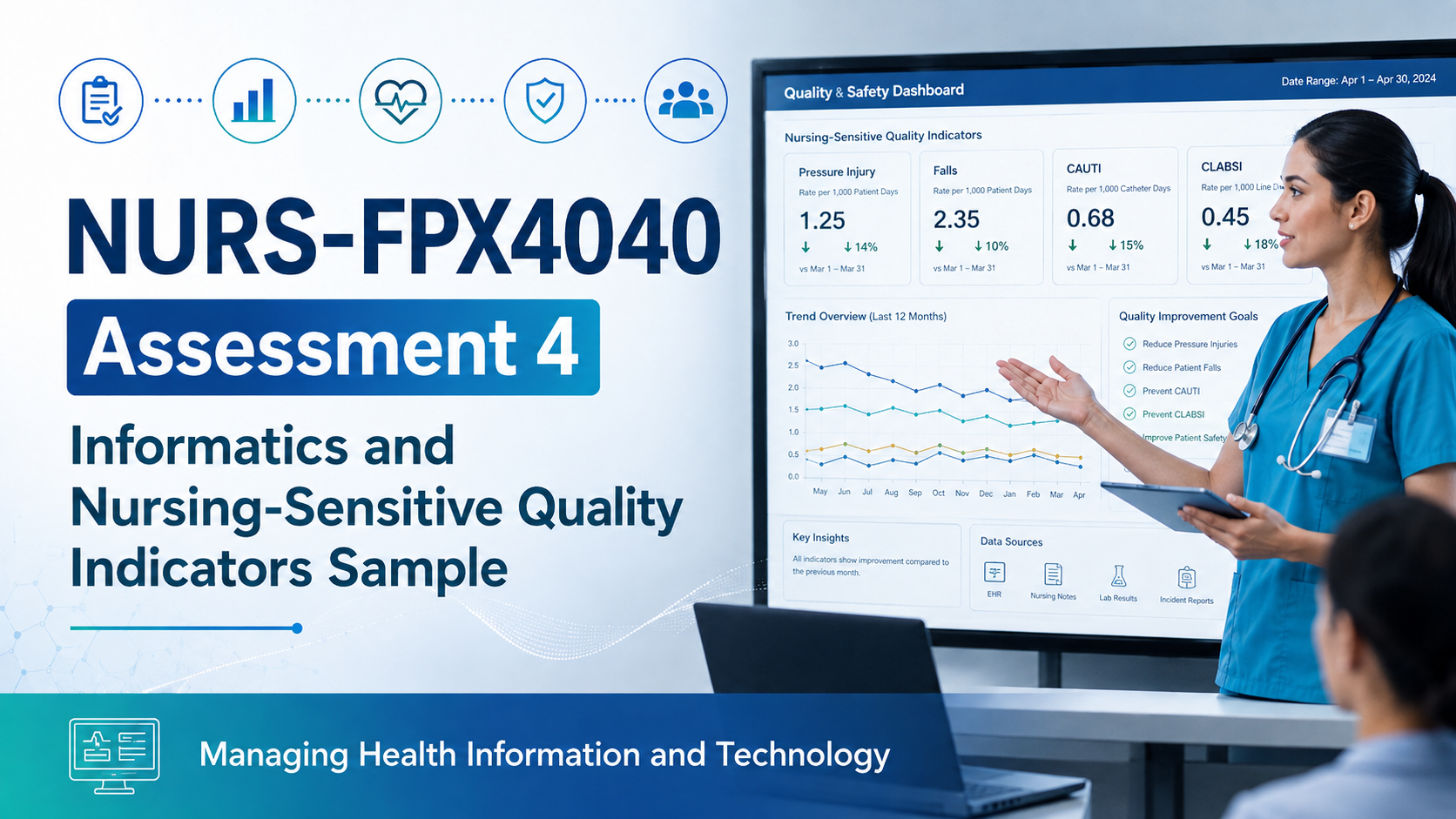
NURS-FPX4040 Assessment 4 is presented here as an independent educational model of an informatics training script. This 8–10 minute sample uses hospital-acquired pressure injuries to show how a learner can define a nursing-sensitive quality indicator, explain data collection and EHR documentation, interpret dashboard information, and connect evidence with practice improvement. The indicator, timing, examples, and structure belong to this model; current instructions and the scoring guide control the learner’s own submission.
Course context: view the NURS-FPX4040 course hub for the course overview and published assessments.
Full NURS-FPX4040 Assessment 4 Sample
NURS-FPX4040 Assessment 4 Informatics and Nursing-Sensitive Quality Indicators Sample
Course: NURS-FPX4040: Managing Health Information and Technology
Assessment: Assessment 4
Sample Type: 8-10 minute new-nurse training tutorial script
Author: FlexPath Assignment Help
Educational sample notice. This original model demonstrates one way to organize a training script about a nursing-sensitive quality indicator. Learners should compare it with the current courseroom instructions and scoring guide, verify all sources, and create their own submission.
Training Topic: Hospital-Acquired Pressure Injury Rate
Estimated delivery time: 8-10 minutes at a normal speaking pace.
Audience: Newly hired nurses in an acute-care hospital.
Indicator type: Nursing-sensitive outcome indicator.
Audio Tutorial Script
Opening
Welcome to the nursing quality orientation. This session focuses on one nursing-sensitive quality indicator that every bedside nurse can influence: the hospital-acquired pressure injury, or HAPI, rate. By the end of this short training, you should understand what the indicator measures, why it matters, how our data are collected and reported, and what you need to do so that the information is accurate enough to improve patient care.
What is a nursing-sensitive quality indicator?
A nursing-sensitive indicator is a measure that reflects the structure, process, or outcome of nursing care. It does not mean nurses are the only people responsible for the result. Instead, it means nursing practice has a meaningful and measurable relationship with the outcome. Pressure injury prevention is a strong example because bedside assessment, repositioning, moisture management, nutrition screening, device care, support surfaces, documentation, and escalation are all influenced by nursing decisions.
Why hospital-acquired pressure injuries matter
A pressure injury is localized damage to skin or underlying tissue that develops because of pressure, shear, or a related mechanism. A HAPI is identified after admission and was not documented as present on admission. These injuries can cause pain, infection risk, longer hospitalization, greater cost, and loss of trust. They also provide important information about whether prevention processes are working. Recent literature continues to identify pressure injury measures as nursing-sensitive indicators linked with patient factors, nursing practice, prevention processes, and organizational structures (Oner et al., 2025).
What our organization measures
We track the number and stage of hospital-acquired pressure injuries, the unit where the injury is identified, whether the injury is device related, patient risk, and prevention actions. Depending on the reporting system, rates may be expressed as injuries per 1,000 patient days or as prevalence or incidence percentages. The exact denominator matters. Never compare two dashboards unless the data definitions match.
How data are collected
The process begins at the bedside. On admission or transfer, nurses complete a skin assessment and a validated pressure-injury risk assessment. Existing wounds must be documented accurately so that later reviewers can distinguish present-on-admission conditions from injuries that developed in the hospital. Throughout the stay, nurses document skin findings, repositioning, support surfaces, moisture or incontinence care, nutrition concerns, device-related pressure checks, wound consultations, and patient or family education.
The EHR converts some of these entries into structured data. Quality teams may also use wound-care documentation, incident reports, unit census or patient-day data, and chart review. Informatics staff help ensure that fields are standardized and that the dashboard pulls the intended data. Monfre and colleagues (2022) showed how inconsistent EHR skin-documentation fields can make communication and pressure-injury prevention harder; their improvement work aligned documentation across services. This is why selecting the right field matters. A free-text note may describe the patient well but can be difficult to count reliably in a quality dashboard.
Your role in data accuracy
Nurses are the first data collectors. If the admission skin assessment is incomplete, a later injury may be misclassified. If a turning intervention is done but not documented, the record suggests that care did not occur. If an injury is charted in the wrong location or with an incorrect category, the quality team may investigate the wrong process. Accurate documentation is therefore not separate from patient care. It is part of the care system.
Use objective descriptions. Follow the organization’s wound-staging policy and consult wound experts when required. Document device-related skin checks in the correct place. If you discover a new skin change, assess it, protect the patient, notify the appropriate clinician or wound specialist, and document the actions. Never alter documentation simply to improve a metric. Ethical quality reporting requires the record to reflect what actually occurred.
How the organization uses the data
Quality data are reviewed at several levels. Unit leaders may review HAPI events, compliance with risk assessments, and prevention-bundle use. The wound-care team may identify trends by injury location or device type. Nursing leadership can compare units and determine where education or resources are needed. The quality council can track changes over time and evaluate whether an intervention is working. Data may also support benchmarking and external reporting, depending on the organization’s programs and requirements.
The important point is that dashboards should lead to learning. If a unit’s HAPI rate rises, the first question should be “What changed in the system?” The team might review staffing patterns, patient acuity, availability of specialty surfaces, delayed equipment, missed skin checks, documentation design, nutrition referrals, or knowledge gaps. Aningalan and Gannon (2023) reported a quality-improvement project that used interdisciplinary collaboration and nurse empowerment to reduce HAPIs to zero for an extended period. The lesson is not that every hospital can promise zero events, but that organized prevention work and staff engagement can produce major improvement.
How informatics supports prevention
Informatics makes quality information visible and actionable. The EHR can prompt risk assessment, display skin findings across transitions, trigger care-plan interventions, or identify high-risk patients. Dashboards can show trends and help leaders target resources. Predictive analytics can estimate risk, although predictions must support rather than replace nursing judgment. A systematic review of machine-learning models for HAPI prediction found promising approaches but also highlighted the need to examine model quality and clinical usefulness (Zhou et al., 2023).
Technology can also fail if it creates excessive alerts or requires duplicate documentation. The nurse informaticist should work with wound specialists and bedside nurses to test whether alerts appear at the right time, whether required fields make sense, and whether data definitions are clear. When you notice that a documentation field does not match clinical practice, report the problem. Frontline feedback is an important source of informatics improvement.
Evidence-based nursing practices
Prevention begins with reliable assessment and a bundle matched to patient risk. Core actions typically include regular skin inspection; repositioning or mobility based on risk and tolerance; heel off-loading when indicated; moisture and incontinence management; nutritional screening and referral; appropriate support surfaces; and careful management of devices and tubing. A 2022 critical-care quality initiative demonstrated that re-engaging nurses in an updated pressure-injury prevention bundle helped reduce HAPI rates when prevention practices had become inconsistent (Coyer et al., 2022).
Education also matters. Chuang and colleagues (2022) found that a digital e-book intervention improved nurses’ knowledge, attitudes, and confidence related to pressure-injury prevention and care. This is relevant to informatics because education technology can reinforce practice at the point of need, but education should be paired with real resources. Nurses cannot follow a prevention bundle if repositioning equipment, heel protection, or specialty surfaces are unavailable.
How to respond to the dashboard
When you see a quality dashboard, do not treat the rate as a grade. Ask what the numerator and denominator mean, whether documentation is complete, what patient population is included, and what process measures explain the outcome. For example, a unit may have a stable HAPI rate while risk-assessment completion is falling. That process trend can signal danger before the outcome worsens. Conversely, a sudden rise in documented pressure injuries may partly reflect better detection and documentation, so event review is needed before drawing conclusions.
Closing expectations for new nurses
Your responsibilities are straightforward. Complete admission and transfer skin assessments on time. Use the approved risk tool. Apply the prevention bundle consistently. Escalate new findings. Document care in the correct EHR fields. Ask for help when staging or classification is uncertain. Report equipment or workflow barriers. Participate in event reviews without blame. Finally, remember that the quality indicator starts with the patient in front of you. Reliable data come from reliable care and honest documentation.
Closing
Hospital-acquired pressure injuries are a nursing-sensitive outcome because bedside nursing actions strongly influence prevention and detection. Informatics allows the organization to collect those actions and outcomes, turn them into usable information, and target improvement. Your documentation is therefore not just a record of the past; it is part of the data system used to protect the next patient. Thank you, and welcome to the team.
References
Aningalan, A. M., & Gannon, B. R. (2023). Driving hospital-acquired pressure injuries to zero: A quality improvement project. Advances in Skin & Wound Care, 36(11), 1-6. https://doi.org/10.1097/ASW.0000000000000056
Chuang, S.-T., Liao, P.-L., Lo, S.-F., Chang, Y.-T., & Hsu, H.-T. (2022). Effectiveness of an e-book app on the knowledge, attitudes and confidence of nurses to prevent and care for pressure injury. International Journal of Environmental Research and Public Health, 19(23), 15826. https://doi.org/10.3390/ijerph192315826
Coyer, F., et al. (2022). Reducing hospital-acquired pressure injuries during the COVID-19 pandemic. Critical Care Nurse, 42(2), 82-91. https://doi.org/10.4037/ccn2022315
Monfre, J., Batchelor, F., & Skar, A. (2022). Improving skin assessment documentation in the electronic health record to prevent perioperative pressure injuries. AORN Journal, 115(1), 53-63. https://doi.org/10.1002/aorn.13573
Oner, B., Kilic, M., Cakar, V., & Karadag, A. (2025). Identification of nursing-sensitive indicators on pressure injuries/ulcers: A systematic review. Nursing Inquiry, 32(2), e70007. https://doi.org/10.1111/nin.70007
Zhou, Y., Yang, X., Ma, S., et al. (2023). A systematic review of predictive models for hospital-acquired pressure injury using machine learning. Nursing Open, 10(3), 1234-1246. https://doi.org/10.1002/nop2.1429
Assessment Coverage Map
| Feature Illustrated in This Sample | Where the Sample Addresses It |
|---|---|
| Explain a selected nursing-sensitive quality indicator. | Training Topic and early script sections. |
| Explain why the indicator is important to quality and patient safety. | Why hospital-acquired pressure injuries matter. |
| Describe how data are collected and disseminated. | How data are collected; How the organization uses the data. |
| Explain nurses’ role in accurate reporting and high-quality outcomes. | Your role in data accuracy; Closing expectations. |
| Describe informatics and evidence-based practices that support improvement. | How informatics supports prevention; Evidence-based nursing practices. |
| Uses an 8-10 minute audio-tutorial format in this sample. | Complete natural-language script designed for normal speaking pace. |
How This Sample Is Organized
This sample demonstrates one way to organize a training script for new clinical staff. It includes:
- Nursing-Sensitive Indicator: Defines the HAPI rate and explains its relationship with bedside nursing care.
- Data Collection and EHR Integration: Shows how documentation can become structured quality data.
- Nurses’ Role in Data Accuracy: Connects documentation practices with interpretation of quality results.
- Organizational Use of Data: Explains how leaders and clinical teams can use trends and benchmarks to guide improvement.
- Informatics and Prevention: Discusses decision support, predictive models, education technology, and evidence-based prevention.
- Presentation Format: Uses an 8–10 minute natural-language script for this model.
The selected indicator, timing, section order, examples, and evidence belong to this sample. Learners should follow the current instructions, scoring guide, faculty guidance, and clinical or organizational policy.
NURS-FPX4040 Assessment 4 Informatics and Nursing-Sensitive Quality Indicators Overview
Analytical Moves Demonstrated in the Sample
This model illustrates the following analytical moves. Adapt them to the indicator, format, evidence, and criteria in the current instructions:
- Define a selected nursing-sensitive quality indicator and explain why it matters in the stated care context.
- Describe how relevant data are collected, validated, stored, reported, and interpreted through health information systems.
- Explain how nursing documentation and workflow affect data quality without assuming that one factor alone determines patient outcomes.
- Connect evidence-based practices to the selected indicator and the population or setting addressed.
- Analyze how informatics tools may support clinical judgment, measurement, and continuous improvement while acknowledging limitations.
Helpful resources for this assessment
Assessment hierarchy
- NURS-FPX4040 course hub — course overview and published assessments.
- Nursing & Health Sciences sample collection — lateral browsing across the wider program area.
Supporting guides for evidence and implementation
- Capella FlexPath BSN Assignment Help Use this guide for the specific method, evidence need, or revision step indicated by its topic.
- BSN Patient Safety Assignment Guide Use this guide to connect safety problems with evidence-based interventions and measurable outcomes.
- 7 Steps for an Academic Source Evaluation Checklist Use this guide to locate and evaluate recent scholarly evidence for claims made in the assessment.
- How to Find Recent Nursing Research Use this guide to locate and evaluate recent scholarly evidence for claims made in the assessment.
- NURS-FPX4040 Course Resources Use this guide to locate and evaluate recent scholarly evidence for claims made in the assessment.
Frequently asked questions
What does this NURS-FPX4040 Assessment 4 sample cover?
It demonstrates one way to explain a nursing-sensitive quality indicator, EHR data collection, documentation quality, dashboard interpretation, and evidence-based improvement in a staff-training script.
Must I use HAPI, an 8–10 minute format, or six sources?
Not unless those choices appear in the current instructions. They belong to this model. Confirm the active requirements, select an appropriate indicator and evidence, and create an original tutorial.
Can I submit this sample as my own assessment?
No. Use it to study organization and reasoning, then write an original script based on your selected indicator and verified evidence.
Does this resource replace current course or clinical guidance?
No. It is independent educational support and does not replace current assessment directions, the scoring guide, faculty guidance, evidence-based clinical guidance, or organizational policy.
Study and academic-use guidance
Use this sample to study structure, evidence relationships, analytical sequencing, and scoring-guide alignment. Build your own response from the current courseroom requirements.
- Verify the current instructions, template, evidence requirements, and scoring guide.
- Create your own analysis, calculations, visuals, citations, and conclusions.
- Check factual, clinical, legal, numerical, and source claims before submission.
Independent resource: FlexPath Assignment Help is not affiliated with or endorsed by Capella University. Do not submit sample wording or analysis as your own work.