About NURS-FPX4035 Assessment 1
This NURS-FPX4035 Assessment 1 sample models a quality-and-safety analysis of a fictional inpatient fall involving an older adult on a medical-surgical unit. It shows how clinical, workflow, communication, and environmental factors can be connected to evidence-based fall-prevention strategies, nursing coordination, stakeholder roles, and organizational costs.
Course context: view the NURS-FPX4035 course hub for the course overview and published assessments.
Quality-and-Safety Analysis Structure
This sample critically evaluates the multifactorial causes of an inpatient fall and outlines an actionable prevention strategy. It is organized around the following sections:
Factors Leading to the Patient Safety Risk: Breaks down the incident into specific patient factors (advanced age, delirium), task/workflow factors (paused bed alarms), communication gaps (incomplete day-to-night handoffs), and environmental issues (distant rooms).
Evidence-Based and Best-Practice Solutions: Proposes the adoption of the Fall TIPS model to create tailored prevention plans displayed at the bedside, paired with patient education and structured teach-back methods.
Reducing Organizational Costs: Analyzes the economic value of preventing both injurious and non-injurious falls without creating pressure to underreport safety events.
How Nurses Coordinate Care for Safety and Value: Details the registered nurse's role in reassessing risk, escalating clinical changes, conducting safety huddles, and updating interventions during bedside handoffs.
Stakeholders Required to Drive Safety Enhancements: Maps out the specific contributions required from patients, charge nurses, clinical educators, advanced practice clinicians, and executive leaders to sustain the safety initiative.
How the Root-Cause Analysis Leads to a Safety Improvement Plan
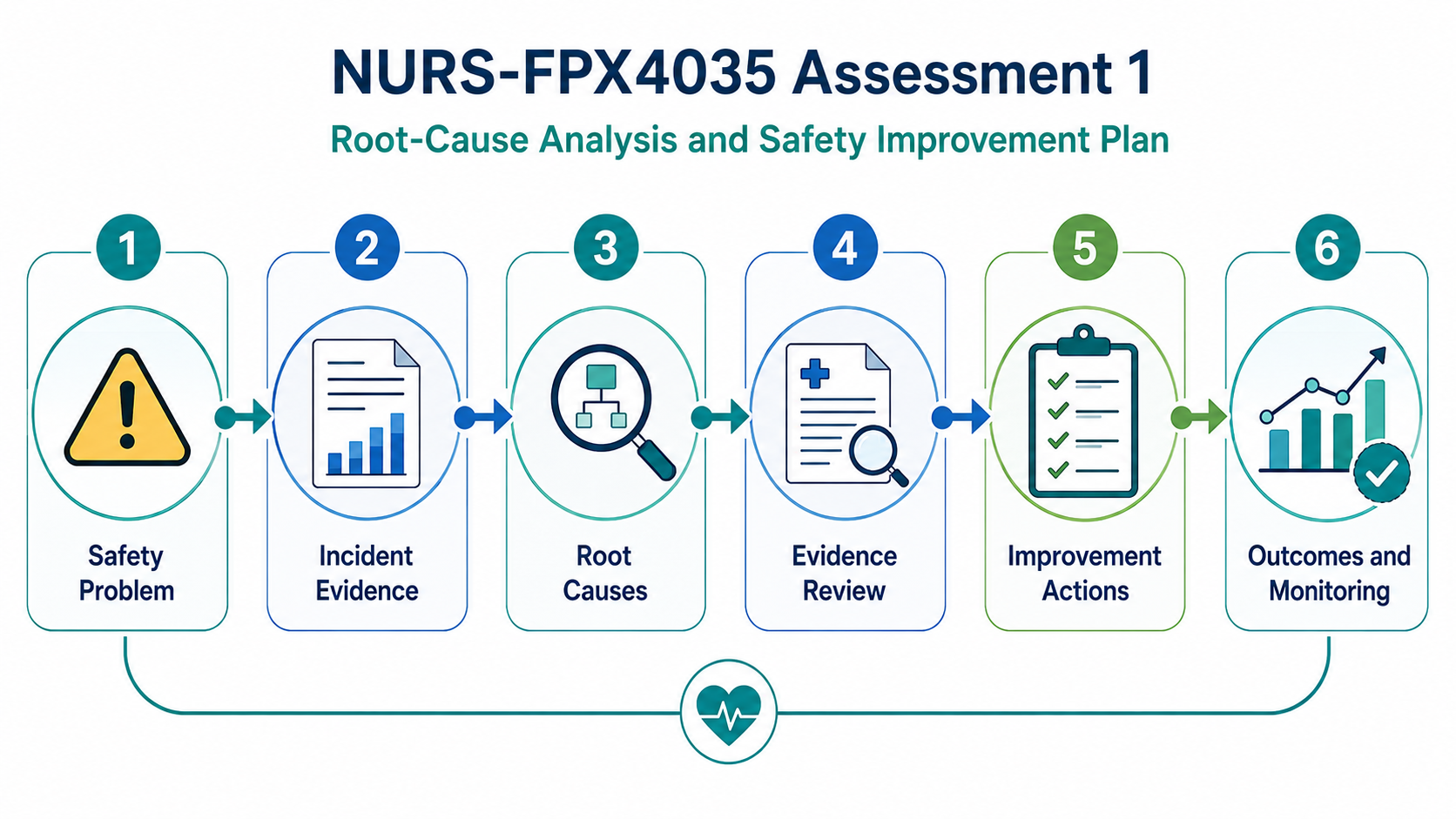
Patient-Safety Analysis Steps
Use these analysis points to review the sample and plan an original response:
- Define a specific patient-safety problem, such as an inpatient fall resulting from dynamic clinical risks, interacting medications (sedatives and loop diuretics), and fluctuating cognition.
- Connect precise system conditions—like lean night staffing, inaccessible call lights, and generic risk labels—directly to the resulting risk and patient harm.
- Identify evidence-based prevention strategies, including individualized risk-plan-execution processes and scheduled toileting protocols.
- Address financial impacts by evaluating how evidence-based fall programs avoid direct costs, such as extended lengths of stay, diagnostic imaging, and sitter use.
- Explain how registered nurses and interprofessional partners (PT, OT, pharmacy, physicians) share specific responsibilities in executing safety protocols
Helpful resources for this assessment
Assessment hierarchy
- NURS-FPX4035 course hub — course overview and published assessments.
- Nursing & Health Sciences sample collection — lateral browsing across the wider program area.
Supporting guides for evidence and implementation
- BSN Patient Safety Assignment Guide Connects an inpatient-fall problem to contributing system factors, feasible interventions, stakeholder roles, and measurable patient-safety outcomes.
- How to Write a BSN Evidence-Based Practice Paper Supports appraisal and synthesis of evidence used to justify the selected fall-prevention strategies.
- 9 Steps to Plan a Capella Nursing Change Proposal Shows how to translate prevention evidence into workflow changes, stakeholder responsibilities, implementation steps, and sustainability planning.
- How to Find Recent Nursing Research for an Assessment Provides search strategies for locating recent peer-reviewed nursing and patient-safety evidence in appropriate databases.
- 10 Steps to Track Evidence for Every Rubric Criterion Helps map analytical claims, supporting evidence, and required sections to the current assessment criteria.
- Next: Assessment 2 Root-Cause Analysis and Safety Improvement Plan Sample Use this guide for the specific method, evidence need, or revision step indicated by its topic.
Frequently asked questions
What does this NURS-FPX4035 Assessment 1 sample analyze?
It analyzes a fictional inpatient fall during nighttime toileting, including patient risks, workflow and communication gaps, environmental factors, prevention strategies, nursing coordination, stakeholder roles, and organizational costs.
How should the safety problem connect to the proposed intervention?
Explain the strongest contributing factors first, then show how each proposed action addresses those factors. Include outcome, process, and balancing measures when they are relevant to the current instructions.
How should organizational cost and stakeholder roles be discussed?
Connect preventable harm to specific resource effects without encouraging underreporting, and explain what nurses, patients, clinical partners, educators, and leaders would contribute to the improvement work.
Can I submit this sample as my own assessment?
No. Use it only as a learning model. Develop an original analysis, use evidence appropriate to your chosen safety issue, cite borrowed ideas, and follow the current courseroom instructions and scoring guide.
Study and academic-use guidance
Use this sample to study structure, evidence relationships, analytical sequencing, and scoring-guide alignment. Build your own response from the current courseroom requirements.
- Verify the current instructions, template, evidence requirements, and scoring guide.
- Create your own analysis, calculations, visuals, citations, and conclusions.
- Check factual, clinical, legal, numerical, and source claims before submission.
Independent resource: FlexPath Assignment Help is not affiliated with or endorsed by Capella University. Do not submit sample wording or analysis as your own work.