About NURS-FPX4035 Assessment 4
This NURS-FPX4035 Assessment 4 sample models a practical resource toolkit for implementing, communicating, monitoring, and sustaining a fall-prevention improvement plan. It shows how scholarly and professional resources can be grouped by staff need, annotated for clinical use, and connected to evidence-based prevention, team engagement, measurement, and sustainability.
Course context: view the NURS-FPX4035 course hub for the course overview and published assessments.
Improvement Toolkit Structure
This sample curates and annotates evidence for a fall-prevention rollout. It is organized around the following toolkit sections:
Category 1: Understanding Risk, Harm, and Organizational Cost: Provides resources (like the Dykes et al. economic evaluation) to help leaders build a business case and understand the clinical burden of inpatient falls.
Category 2: Evidence-Based Prevention Design: Integrates systematic reviews and the AHRQ Fall TIPS toolkit to guide the creation of personalized, bedside prevention plans rather than relying strictly on bed alarms.
Category 3: Patient, Family, Nursing, and Team Engagement: Supplies tools and qualitative studies that support respectful teach-back methods and structured handoffs.
Category 4: Implementation, Measurement, and Sustainability: Provides evidence on deploying rapid audit/feedback cycles, PDSA iterations, and champion-led coaching to ensure the initiative succeeds long-term.
Toolkit Navigation and Sustainability Plan: Features a scenario-based Toolkit Use Map and outlines how educators and quality champions must maintain the repository post-launch.
Assessment 4 Improvement Toolkit at a Glance
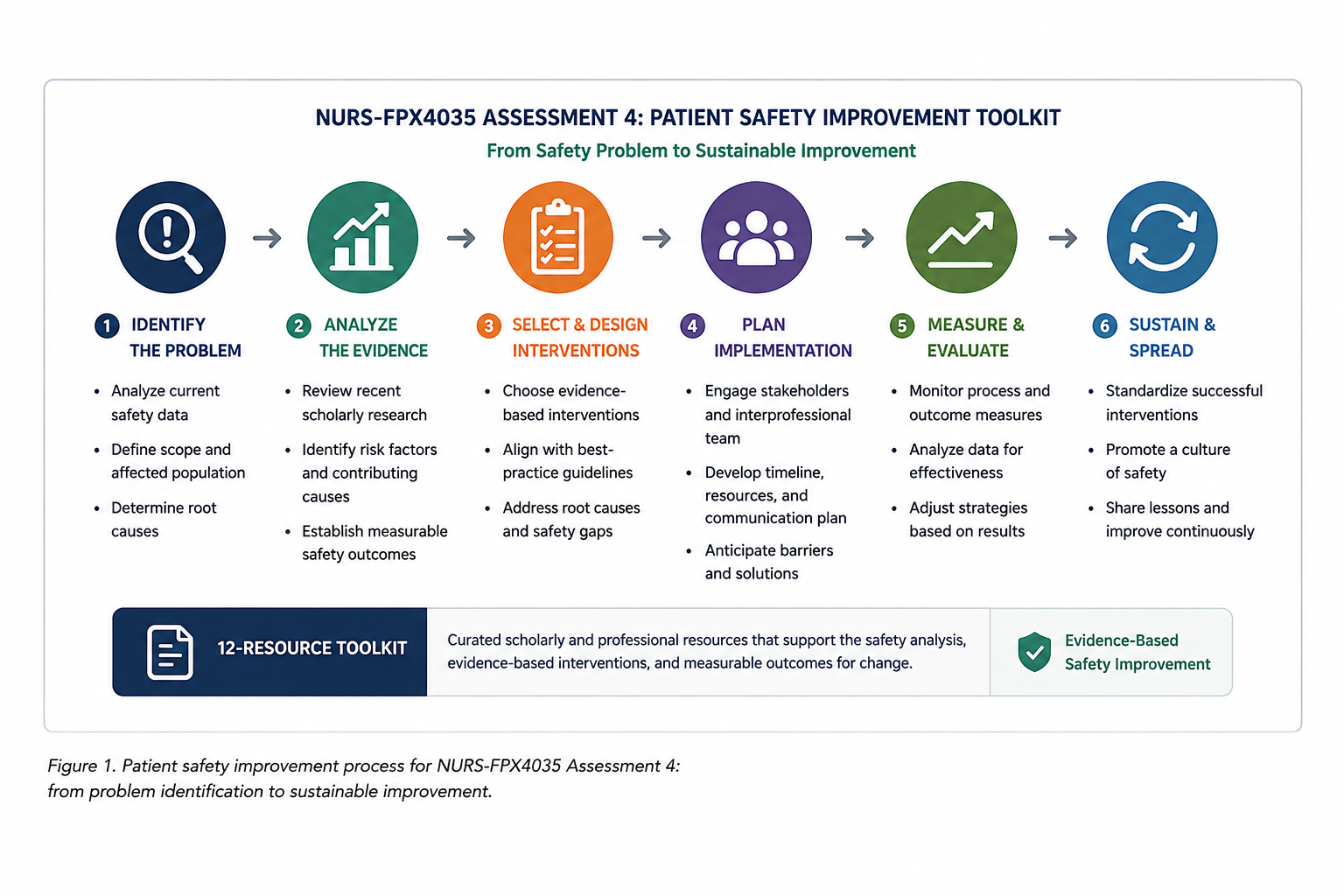
Toolkit Organization and Use Steps
Use these organizational points to review the sample and build an original improvement toolkit:
- Group 12 current scholarly and professional resources into logical, practical categories tailored to the intended clinical user.
- Explain the specific information, clinical value, and exact usage scenarios for every curated resource.
- Include specific evidence-based communication and monitoring tools, such as the AHRQ Fall TIPS toolkit and TeamSTEPPS 3.0 frameworks.
- Support long-term sustainability by developing actionable deployment tools, such as a Frontline Quick-Start Checklist and a Toolkit Use Map
- Avoid simply collecting sources without practical application; each resource must address a specific implementation barrier or staff need
Educational Support and Resource Integration
Assessment hierarchy
- NURS-FPX4035 course hub — course overview and published assessments.
- Nursing & Health Sciences sample collection — lateral browsing across the wider program area.
Supporting guides for evidence and implementation
- BSN Patient Safety Assignment Guide Provides patient-safety and root-cause concepts that help justify the toolkit's fall-prevention focus.
- How to Write a BSN Evidence-Based Practice Paper Supports appraisal and synthesis of the scholarly and professional evidence selected for the toolkit.
- 9 Steps to Plan a Capella Nursing Change Proposal Helps organize staff workflows, champion responsibilities, implementation steps, monitoring, and sustainability resources.
- How to Find Recent Nursing Research for an Assessment Provides search and selection strategies for locating current, relevant nursing and patient-safety evidence.
- 10 Steps to Track Evidence for Every Rubric Criterion Helps check that resource categories and annotations address the current assessment criteria without leaving unsupported gaps.
- NURS-FPX4035 Course Resources Use this guide to locate and evaluate recent scholarly evidence for claims made in the assessment.
Frequently asked questions
What does this NURS-FPX4035 Assessment 4 sample demonstrate?
It demonstrates how a fall-prevention toolkit can group evidence, implementation tools, communication resources, measurement guidance, and sustainability supports for frontline staff.
What should each resource annotation explain?
State what the resource contains, why it is credible and relevant, which staff member or stakeholder would use it, when it would be used, and how it supports the improvement plan.
How can the toolkit support implementation rather than become a source list?
Organize resources around practical tasks, such as understanding risk, carrying out the prevention workflow, engaging patients and team members, monitoring results, and maintaining the change.
Can I submit this sample as my own assessment?
No. Use it only as a learning model. Locate and appraise resources appropriate to your own safety issue, write original annotations, and follow the current courseroom instructions and scoring guide.
Study and academic-use guidance
Use this sample to study structure, evidence relationships, analytical sequencing, and scoring-guide alignment. Build your own response from the current courseroom requirements.
- Verify the current instructions, template, evidence requirements, and scoring guide.
- Create your own analysis, calculations, visuals, citations, and conclusions.
- Check factual, clinical, legal, numerical, and source claims before submission.
Independent resource: FlexPath Assignment Help is not affiliated with or endorsed by Capella University. Do not submit sample wording or analysis as your own work.